“Cheng Ming” — 誠明 — means moral and righteous understanding. It was the nickname of Great-Grand Master Wang Shu-Jin, and it has named this art ever since.
Renowned Xingyi and Bagua masters of early-20th-century Tianjin. As Chief of Police, Zhang Zhao-Dong earned the names “Son of Tiger and Panther” and “Lightning-Hands Zhang” — Wang Shu-Jin began training under him in 1921, at the age of sixteen.
Synthesised stance training, Xingyi Chuan and Bagua Zhang into the Cheng Ming (Zhongnan) system, and in 1929 developed the “Orthodox Style” Tai Chi Chuan from the five major family styles. Moved from Tianjin to Taichung, Taiwan in 1949, and spent twenty years teaching across Japan from 1959 onward, building the international reach the art has today.
President and Head Coach of the International Cheng Ming Martial Arts Association. Together they continue to teach the Zhongnan system in Taiwan and travel to branches across Japan, Israel, Australia, Europe, Argentina and the USA.
Have studied directly under Grand Master Wang Fu-Lai for over twenty-five years, coordinating the Australian group's annual training trips to Taiwan.
Founded by Richard Roberts, a student of David & Amelia Zarb, bringing the Zhongnan lineage to Warragul and Trafalgar.
Born in Tianjin on 20 June 1905, Wang Shu-Jin (courtesy name Heng-Sun) began formal training in 1921 under Zhang Zhao-Dong, later receiving further instruction from senior masters Li Cun-Yi and Xiao Hai-Bo — a grounding in stance training, Xingyi Chuan, Bagua Zhang, and the philosophical roots of the art in Confucian, Taoist and Buddhist thought.
In 1929, gathered with other leading Tai Chi masters at the invitation of the Nanjing Central Martial Arts Academy, he distilled the essence of the major family forms into what became the “Orthodox Style” — the hundred-movement Cheng Ming Tai Chi Chuan still taught today.
He moved to Taiwan in 1949, establishing the Chengming Martial Arts Academy in Taichung, and from 1959 began two decades of teaching across Japan, where he built dojos in Tokyo and trained students from every background — including senior practitioners of karate, judo and aikido. Over a long public career he served as an advisor, judge and committee member for Taiwan's national martial arts bodies, and remained devoted to the art until his death, hoping only that “this lineage will be passed down for eternity, benefiting all people.”
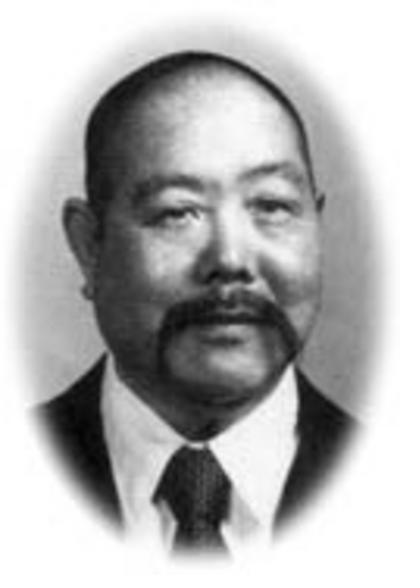
Great-Grand Master Wang Shu-Jin, founder of the Cheng Ming (Zhongnan) system.
Translated from the traditional Chinese charts, preserving the original tree structure. Boxes outlined in brass mark the direct line of the Cheng Ming school — through Zhang Zhao-Dong to Great-Grand Master Wang Shu-Jin, Grand Master Wang Fu-Lai and Grand Master Huang Shu-Chun.
marked names — hover or tap to see their portrait
← swipe / scroll to explore the full chart →
As in many traditional Chinese martial lineages, each generation of the Xingyi–Bagua school is marked by a shared character in its formal name — a way of tracing exactly where a student sits in the line of transmission.
The twenty characters form a poem, read in four lines of five: 海福壽山永 · 強毅定國基 · 昌明光大陸 · 道德見無極 — blessings vast as the sea, longevity enduring as the mountains; strength and resolve set the nation’s foundation; flourishing brightness illuminates the great land; the Way and virtue behold the limitless.
Great-Grand Master Wang Shu-Jin carries the third character in the sequence. From there the line steps down one character per generation — through Grand Master Wang Fu-Lai and Grand Master Huang Shu-Chun, then Master David & Amelia Zarb, to today's Gippsland students in the sixth generation. The characters that follow are held in trust for the generations still to come.
Passing on the torch: second-generation successors Grand Master Wang Fu-Lai and Grand Master Huang Shu-Chun teach the following series, spread today across branches in Japan, France, the UK, Israel, Italy, the USA, Australia, New Zealand, Argentina and Canada. Below is the full syllabus as trained in Gippsland — from the daily internal work everything is built on, through to the inner-room Bagua.
Gippsland is one branch among many, all led from the association's headquarters in Taichung, Taiwan. Each of these schools teaches under the same Zhongnan lineage — visit their own sites to learn more about their local classes.